It's been a couple of eventful days since my adding a new post so here goes:
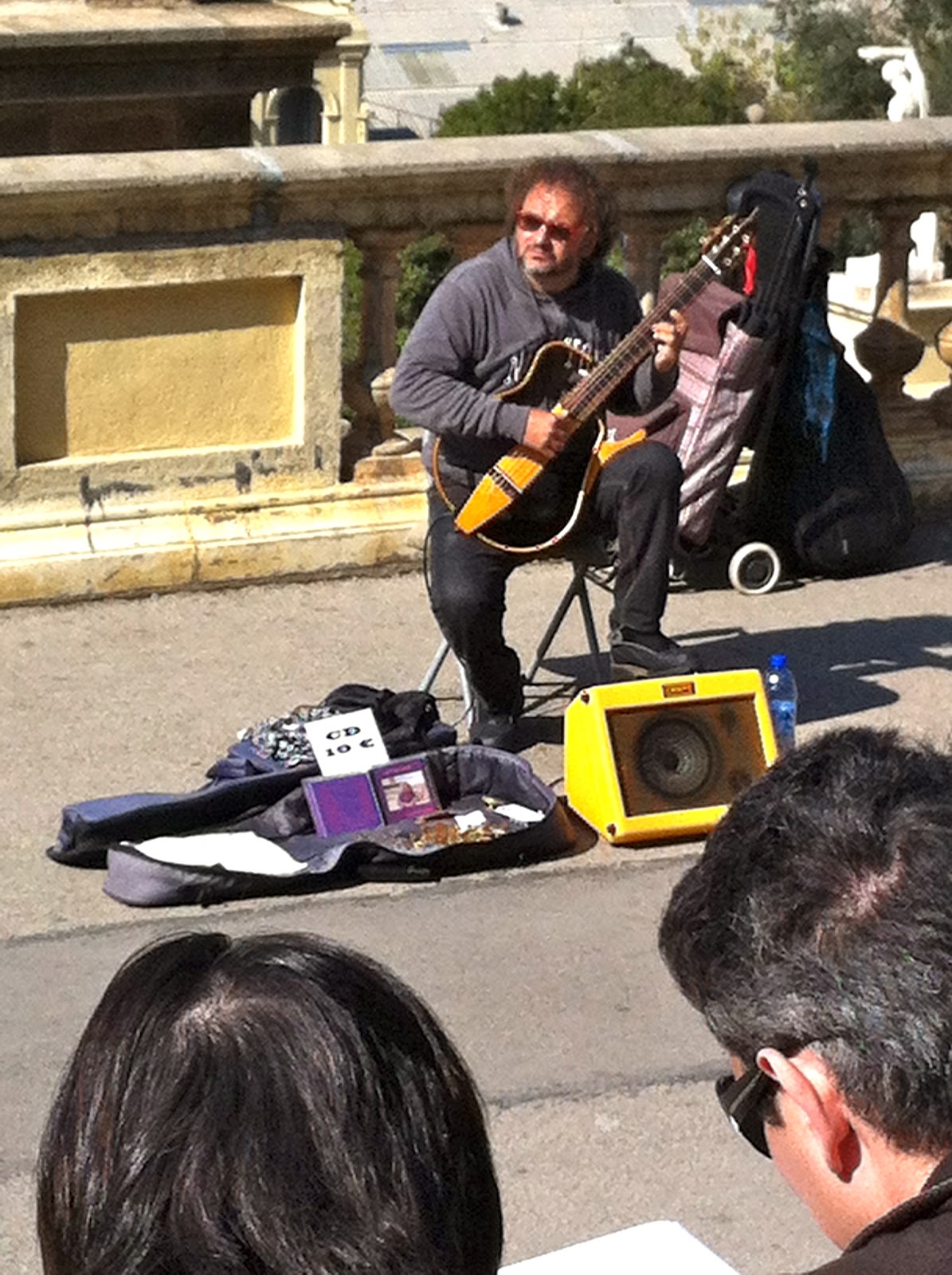
I went to Museum National Art Catalonia MNAC- two days ago. Beyond it's magnificent and ancient facade, there are glorious vistas to be seen overlooking the panorama of the city. There are many, many steps (as usual) to climb to reach the Museum from the Espanya metro station. Thankfully there are also escalators to partly ease the climb. Nearing the top, there's an stepped area where people can sit. I joined the crowd to listen to guitar player, Gaby Sellanes with his sunglasses, and long hair, holding forth on an electronic guitar (Spanish?). I bought his CD.
The old MNAC looks as though its been gutted inside to create its super modern and spacious display areas. Walking through the collection, I noted a surfeit of gloomy medieval (and beyond) faces similar to those to be seen in today's Barcelona metro. Those faces are on the streets, restaurants, and subway looking as though their great, great, great grandparents posed for the paintings, and that their expressions of grief and sorrow have been inherited. I'd first experienced uncanny resemblances in Mexico where faces in ancient art at the Archeological Museum are repeated in modern times.
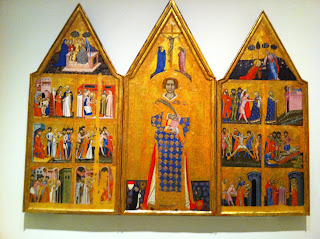
Yes, sad faces are bountifully illustrated in the museum's collection (and even beyond the medieval period), yet their gloom is oftentimes surrounded by stunningly bright colored garments, and oftentimes beautifully gilded backgrounds. These vivid colors (restored?) are a counter-play to the facial expressions. One can easily be dazzled by the overall effect of the artworks, and not take in the aura of tragedy attached to their beings. Even baby Jesus seemed longing for a happier mom.
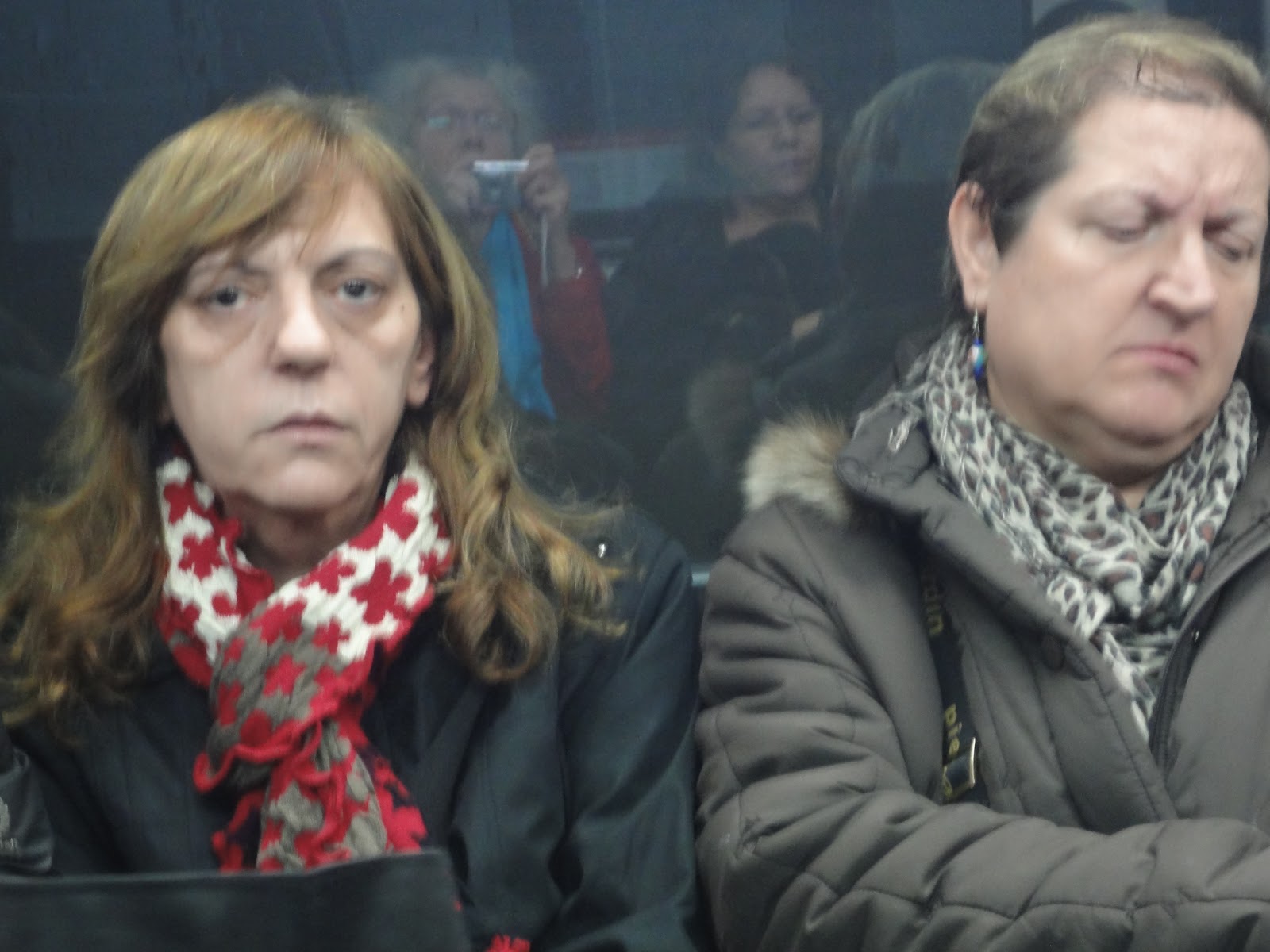
The faces did remind me of subway riders I've been privileged to stare at (since everyone looks away as if fearful of confessing to eye contact). Perhaps there's a deep cultural melancholy here with long-time roots. There were photos from the Spanish Civil War where stories have and will be passed on for times to come. However, it must be said that these last days with the sun shining, I can happily relate that folks are seeming more sunny (or is it me?).
Yesterday turned out to be an important day for me. I went to Girona to visit the Old City and the Jewish Quarter. I thank my friend Gemma for alerting me to this wonderful day trip about 90 minutes by train from the Passeig de Gracia station. Of course I know of the tragedy of the Spanish Jews and their expulsion from Spain in 1492 (that edict wasn't officially rescinded until 1992!), and I've surely read about the inquisition. If my father's Elkiins forebears did migrate from Israel to Spain as daughter Janet discovered when researching family genealogy, I can also feel a cultural and root-bound interest quite regardless more recent centuries have found them in Russia/Poland's Askenazi world. In any case, the display at the Jewish Museum in the very Jewish Quarter where those hapless people experienced its ills, was beyond educational, it brought their historic saga to life.
Before I happening upon the Jewish Museum, I'd been wandering through the Jewish Quarter taking pictures and marveling at the ancient stones, the narrow streets, and the sun streaming down to dramatic effect. Drawn to a particularly steep set of stairs, and reaching the top, I happened upon a beautiful elderly white haired woman locking her door and who then turned in my direction and looked at me. I asked if I could take her picture (see pics). She then asked me if I wanted to see her house. Of course I said yes, and she unlocked the heavy door and shepherded me through what I learned was the famous "House of Eight Mezuzahs." (According to Wikepedia - A mezuzah is affixed to the doorframe in Jewish homes to fulfill the mitzvah (Biblical commandment) to inscribe the words of the Shema "on the doorposts of your house" (Deuteronomy 6:9) ... and ..The commandment to affix a mezuzah is widely followed in the Jewish world, even by Jews who are not religiously observant.)
Upon setting foot in the house, I was overcome with its feeling of peace, serenity and beauty. Deeply struck, I found myself suddenly moved to tears. An unexpected sense of true connection washed over me, a connection to an authentic presence of a past where Jewish people were living in peace and tranquility before the terrible end to their lives in Girona.
I was also moved by this lovely woman who was living her daily life in an ancient house that infused her being with its kindly aura, an aura that she then in turn fed back into its sacred space. She patiently walked me through the features of the house and showed me the hollow areas next to the doors where Mezuzahs had once been placed, and the well with its dated inscription, 1496 indicating that the owners lived on there even after the edict of expulsion. Eventually all Jews were expelled from Girona and the streets of the Quarter were walled off from the rest of the city until it was again restored centuries later.
I finally located the Jewish Museum and spoke about my experience with the elderly woman to the young woman behind the admission desk. I learned that Rosa is the name of the woman who lives in the House of Eight Mezuzahs, and that she's very cooperative with the museum. We agreed that I was very lucky to get that special invitation.
When I travel, I've a sense of why and what I'll want to do along the way. It's to make art, visit with friends, make new friends and to leave space for the unexpected. It is in the unexpected where the gift of a journey lies. Somewhere along the way, as in India last year, I've been fortunate in receiving such a gift. Last year during a mask/story workshop in Mumbai to children of prostitutes and women saved from trafficking, I'd asked the children to give their mask qualities they wanted in their adult life. After many performed mask tales that spoke of career aspirations, one boy about 15 years old said he realized now that he could do anything in life. He spoke again, saying he would never forget that day. I knew then that he was my reason for being in India. On this my third trip to Spain, I'd never before thought to visit an old Jewish Quarter. Yesterday in Girona, I understood that I will never forget the gift from Rosa on that day.
And now the pics:


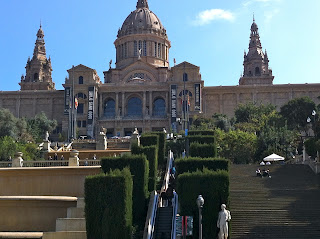




I went to Museum National Art Catalonia MNAC- two days ago. Beyond it's magnificent and ancient facade, there are glorious vistas to be seen overlooking the panorama of the city. There are many, many steps (as usual) to climb to reach the Museum from the Espanya metro station. Thankfully there are also escalators to partly ease the climb. Nearing the top, there's an stepped area where people can sit. I joined the crowd to listen to guitar player, Gaby Sellanes with his sunglasses, and long hair, holding forth on an electronic guitar (Spanish?). I bought his CD.
The old MNAC looks as though its been gutted inside to create its super modern and spacious display areas. Walking through the collection, I noted a surfeit of gloomy medieval (and beyond) faces similar to those to be seen in today's Barcelona metro. Those faces are on the streets, restaurants, and subway looking as though their great, great, great grandparents posed for the paintings, and that their expressions of grief and sorrow have been inherited. I'd first experienced uncanny resemblances in Mexico where faces in ancient art at the Archeological Museum are repeated in modern times.
Yes, sad faces are bountifully illustrated in the museum's collection (and even beyond the medieval period), yet their gloom is oftentimes surrounded by stunningly bright colored garments, and oftentimes beautifully gilded backgrounds. These vivid colors (restored?) are a counter-play to the facial expressions. One can easily be dazzled by the overall effect of the artworks, and not take in the aura of tragedy attached to their beings. Even baby Jesus seemed longing for a happier mom.
The faces did remind me of subway riders I've been privileged to stare at (since everyone looks away as if fearful of confessing to eye contact). Perhaps there's a deep cultural melancholy here with long-time roots. There were photos from the Spanish Civil War where stories have and will be passed on for times to come. However, it must be said that these last days with the sun shining, I can happily relate that folks are seeming more sunny (or is it me?).
Yesterday turned out to be an important day for me. I went to Girona to visit the Old City and the Jewish Quarter. I thank my friend Gemma for alerting me to this wonderful day trip about 90 minutes by train from the Passeig de Gracia station. Of course I know of the tragedy of the Spanish Jews and their expulsion from Spain in 1492 (that edict wasn't officially rescinded until 1992!), and I've surely read about the inquisition. If my father's Elkiins forebears did migrate from Israel to Spain as daughter Janet discovered when researching family genealogy, I can also feel a cultural and root-bound interest quite regardless more recent centuries have found them in Russia/Poland's Askenazi world. In any case, the display at the Jewish Museum in the very Jewish Quarter where those hapless people experienced its ills, was beyond educational, it brought their historic saga to life.
Before I happening upon the Jewish Museum, I'd been wandering through the Jewish Quarter taking pictures and marveling at the ancient stones, the narrow streets, and the sun streaming down to dramatic effect. Drawn to a particularly steep set of stairs, and reaching the top, I happened upon a beautiful elderly white haired woman locking her door and who then turned in my direction and looked at me. I asked if I could take her picture (see pics). She then asked me if I wanted to see her house. Of course I said yes, and she unlocked the heavy door and shepherded me through what I learned was the famous "House of Eight Mezuzahs." (According to Wikepedia - A mezuzah is affixed to the doorframe in Jewish homes to fulfill the mitzvah (Biblical commandment) to inscribe the words of the Shema "on the doorposts of your house" (Deuteronomy 6:9) ... and ..The commandment to affix a mezuzah is widely followed in the Jewish world, even by Jews who are not religiously observant.)
Upon setting foot in the house, I was overcome with its feeling of peace, serenity and beauty. Deeply struck, I found myself suddenly moved to tears. An unexpected sense of true connection washed over me, a connection to an authentic presence of a past where Jewish people were living in peace and tranquility before the terrible end to their lives in Girona.
I was also moved by this lovely woman who was living her daily life in an ancient house that infused her being with its kindly aura, an aura that she then in turn fed back into its sacred space. She patiently walked me through the features of the house and showed me the hollow areas next to the doors where Mezuzahs had once been placed, and the well with its dated inscription, 1496 indicating that the owners lived on there even after the edict of expulsion. Eventually all Jews were expelled from Girona and the streets of the Quarter were walled off from the rest of the city until it was again restored centuries later.
I finally located the Jewish Museum and spoke about my experience with the elderly woman to the young woman behind the admission desk. I learned that Rosa is the name of the woman who lives in the House of Eight Mezuzahs, and that she's very cooperative with the museum. We agreed that I was very lucky to get that special invitation.
When I travel, I've a sense of why and what I'll want to do along the way. It's to make art, visit with friends, make new friends and to leave space for the unexpected. It is in the unexpected where the gift of a journey lies. Somewhere along the way, as in India last year, I've been fortunate in receiving such a gift. Last year during a mask/story workshop in Mumbai to children of prostitutes and women saved from trafficking, I'd asked the children to give their mask qualities they wanted in their adult life. After many performed mask tales that spoke of career aspirations, one boy about 15 years old said he realized now that he could do anything in life. He spoke again, saying he would never forget that day. I knew then that he was my reason for being in India. On this my third trip to Spain, I'd never before thought to visit an old Jewish Quarter. Yesterday in Girona, I understood that I will never forget the gift from Rosa on that day.
And now the pics: